*This is based on the dangers they pose to humans and no size, speed, strength, or bite force. This list also includes an article about said dinosaur.
1.Maip Macrothorax
What was Maip Macrothorax?
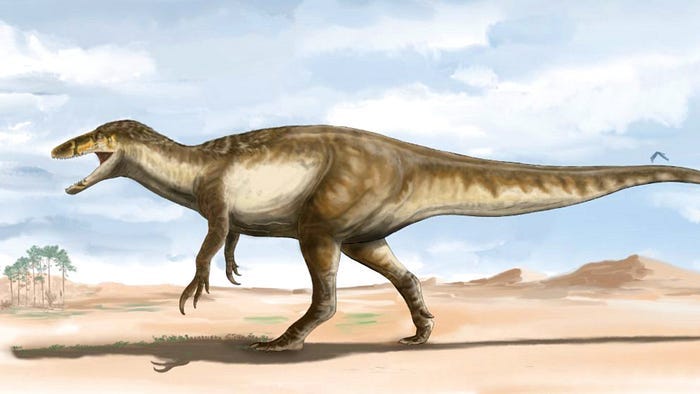
Maip Macrothorax was one of the most deadly carnivores in its region. The name Maip Macrothorax means “Shadow of death with a large chest” which is inspired by a malevolent spirit from Aonikenk mythology. Maip Macrothorax was found in Patagonia and was described in 2022. Maip Macrothorax was from an interesting family called Megaraptorids.
Press enter or click to view image in full size
Size and build
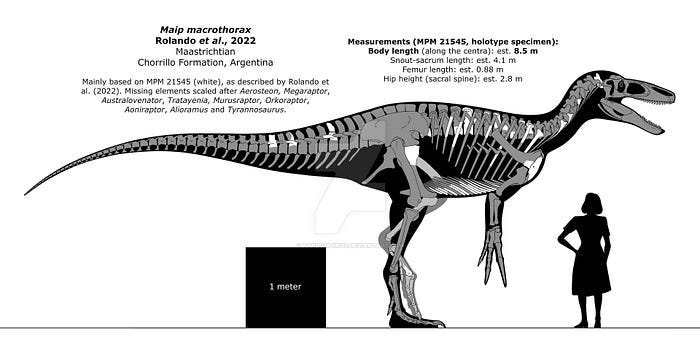
Though, not T-rex sized, Maip Macrothorax was still no pushover being a mind-blowing 9–10 meters (30–33 ft) and 1–2 tons. Maip Macrothorax was like a middle point between a raptor and T-rex because it had a good size but still a lean, fast, hunter with deadly arms and claws capable of shredding through flesh. It also had an extremely wide ribcage- hence Macrothorax.
Press enter or click to view image in full size
The Weapon
Unlike T-rex or Giganotosaurus, Maip Macrothorax was not all bite- far from it, actually. Maip Macrothorax had strong shoulder joints for its enormous claws to tear flesh and bone alike. The wider shoulders suggest that Maip Macrothorax had bigger muscle attachment zones and didn’t lose it’s balance while pulling a powerful swing. Now let’s move down to the arms. Maip Macrothorax had arms bigger than the average theropod with much better functioning then other theropods, too. They were easily capable of grabbing prey and holding animals during intense struggles. Maip Macrothorax’s shoulders also help when it’s slashing, using its claws. Which brings us to the most iconic part of Maip Macrothorax — the claws.
Press enter or click to view image in full size
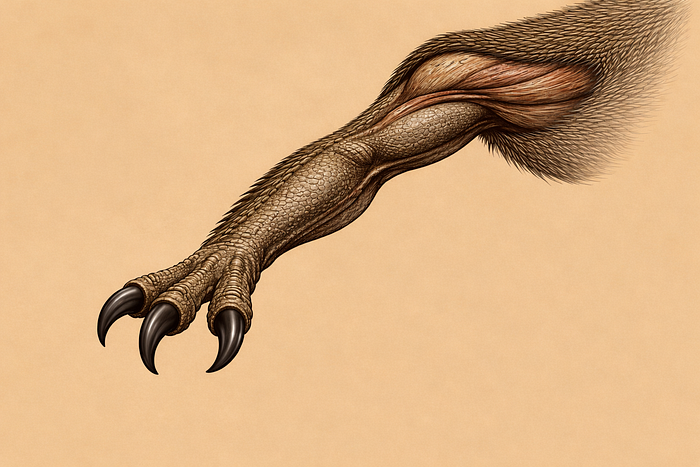
Maip Macrothorax used it’s claws to slash prey and inflict devastating wounds. Maip Macrothorax’s claws are estimated to be the largest claws of any dinosaur we have found so far (We haven’t found Maip Macrothorax’s claws YET). Maip Macrothorax had sharp and really large claws but Maip Macrothorax had a longer dominant claw. Maip Macrothorax’s claws were like meat hooks- built for heavy slashing not delicate grabbing.
Hunting style
Maip Macrothorax didn’t just get food from the sky- it had to hunt for it. So, Maip Macrothorax created its own style of hunting. Maip Macrothorax was most probably a pursuit hunter which means it was fast and had a active lifestyle. Maip Macrothorax most likely would have first pursued it’s prey, then used it’s most dangerous weapons- it’s hands, then weaken the prey, then do the finishing blow with it’s jaws.
2.Tyrannosaurus Rex
What was Tyrannosaurus Rex
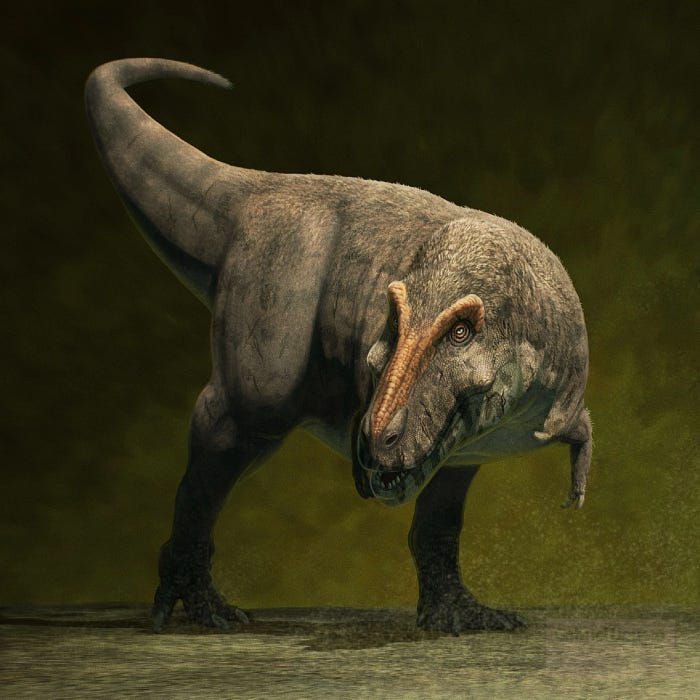
Tyrannosaurus Rex was part of a group called tyrannosauridae which includes less famous relatives like Guanlong, Tarbosaurus, Zhuchengtyrannus, and still there are more. Tyrannosaurus Rex means “Tyrant lizard king” — it’s derived from a combination of greek and latin. it lived 68–66 million years ago, right before the Cretaceous — Paleogene extinction event. Tyrannosaurus Rex fossils are usually found in the Hell Creek Formation which is in North America.
Press enter or click to view image in full size
Size and Build
Tyrannosaurus Rex was one of the most biggest theropod, being an absolute unit — weighing at around 10 tons and being 40–43 feet (12–13 meters) long. Tyrannosaurus Rex wasn’t short either, because its hip hight was 12–13 feet (3.6–3.9 meters).
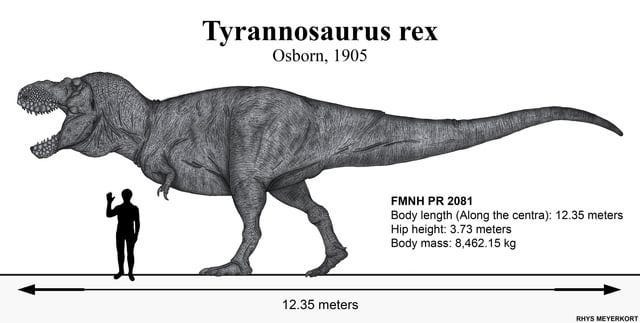
Tyrannosaurus Rex was built like a tank. It had massive muscle attachments in places like the neck, legs, and tails. But it didn’t only have muscles — Tyrannosaurus Rex had heavy dense bones. All of this gave it strength and durability.
Tyrannosaurus Rex also had robust legs, being thick, column-like legs making it have great endurance, but not really fast, seeing that Tyrannosaurus Rex went 20 mph. Tyrannosaurus Rex’s thighs were huge and the primary source of locomotive power — giving powerful bursts of speed when needed. Tyrannosaurus Rex’s 3 toed claws were sharp, and had strong grip and shock absorption.
Tyrannosaurus Rex’s bite may have be the most famous feature, but it can really do that only because of its robust neck. The neck muscles were extremely thick allowing for a better bite and clamp on prey. The massive muscles were anchored into the vertebrae giving an even stronger grip on the skull.
Tail
Tyrannosaurus Rex had a powerful and muscular tail, reinforced with interlocking vertebrae, making it more stiff and powerful than whip-like. It was like a counter weight to the enormous head, allowing Tyrannosaurus Rex to maintain balance while running.
Bite force
Tyrannosaurus Rex had its famous bite force which is anywhere from 35,000 — to all the way up to 60,00. And that’s just average because there are some which standed out for the rest. Here’s a list showing their bite forces:
T-rex Bit force list (Newtons)
Goliath: 63,000
Sue: 60,000
Scotty: 57,000
E.D. Cope: 57,000–64,000
Stan: 57,000
*Remember — anywhere from 55,00 and above is outstanding bite force.
Press enter or click to view image in full size
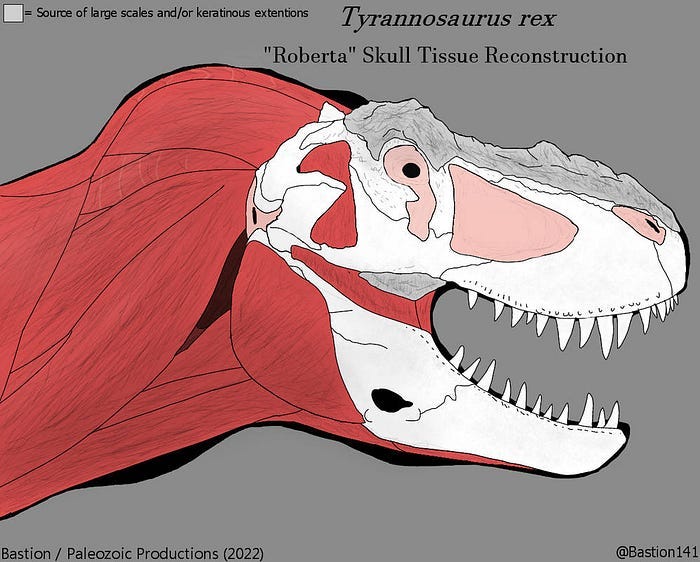
Tyrannosaurus Rex’s skull played a big role in the famous bite force Tyrannosaurus Rex has. Thick, fused bones reduce flex under pressure when T-rex is biting down during a long period of time. Another thing that helps is that the reinforced nasal bones acted like shock absorbents — putting less pressure on the skull. All of these traits made Tyrannosaurus Rex’s skull “crush resistant”.
The jaw was the center of the power. The jaw muscles of Tyrannosaurus Rex were massive and densely packed, especially in the on the side of the skull, which created bites exceeding any land predator ever. The large muscle attachment sites and a deep skull, gave the muscles excellent leverage, letting Tyrannosaurus Rex bite with insane force.
The Myth
Most people think that Tyrannosaurus Rex’s arms were puny and weak. Well, that couldn’t be farther from the truth. Tyrannosaurus Rex’s arms were really strong, capable of lifting 400 pounds. They were most likely used for gripping prey during struggles, and helping stand up.
The Thought
Tyrannosaurus rex was one of the most powerful land predators to ever live, built for strength rather than speed.
With bone-crushing jaws, massive muscles, and a perfectly balanced body, it dominated its ecosystem.
It could hunt large prey, scavenge efficiently, and even consume bones for extra nutrients.
More than just a dinosaur, T. rex was a true apex force of nature.
3.Giganotosaurus carolinii
What Was Giganotosaurus?
Giganotosaurus’s full name is Giganotosaurus carolinii. The name means “Carolini’s giant southern lizard”. The part Carolini, refers to the paleontologist Rubén Darío Carolini who was the paleontologist who found Giganotosaurus carolini. Giganotosaurus carolinii was found in Patagonia, Argentina in the Candeleros formation.
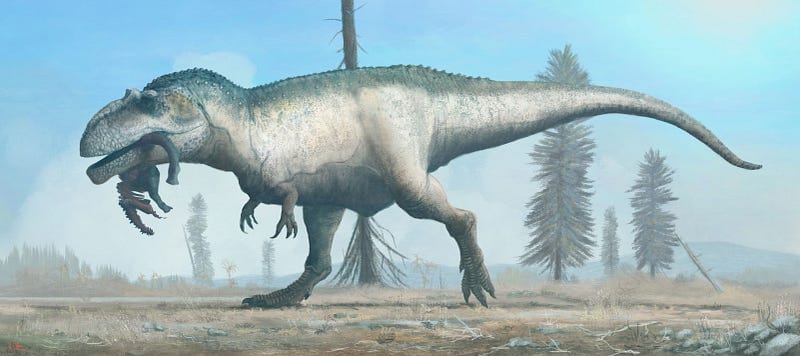
it 99–97 million years ago in the late Cretaceous. The clade was Carcharodontosauridae which includes lesser famous relatives like Mapusaurus and Carcharodontosaurus. One impressive thing was that when the holotype was uncovered, 70% of the skeleton was found which is great for a megatheropod.
Build
Giganotosaurus carolinii was a really big theropod rivaling T-rex. Its length was 39–43 feet (12–13 meters) and weighed 6–9 tons which is light for a predator of its size. Giganotosaurus carolinii’s skull was massive, being 1.5–1.6.
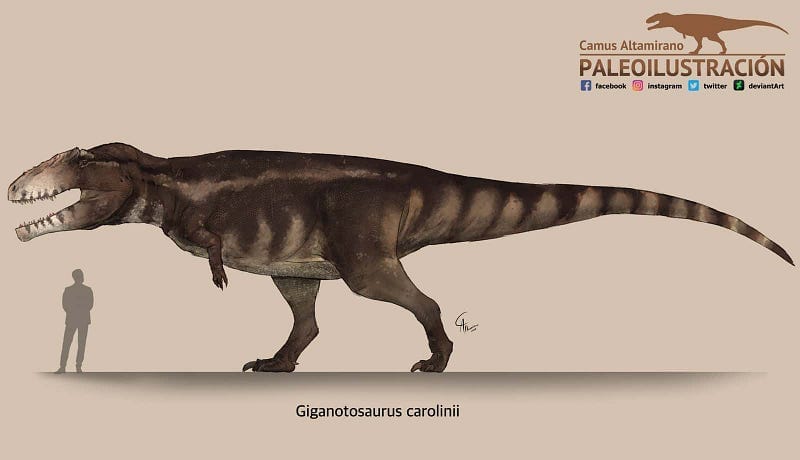
Giganotosaurus carolinii had large pores in the skeleton to make it lighter while still having the size of T-rex. The vertebrae was long and narrow stretching out the frame. The result of these adaptations was a large predator with a lightweight build.
Giganotosaurus carolinii was fast but the thing was that while running it couldn’t turn properly. This led to the idea that they hunted sauropods because- unlike T-rex where it had to face agile prey like Triceratops (yes, Triceratops was agile)- Giganotosaurus wouldn’t have had to turn to hunt. All it needed was speed reaching 30 mph. The Legs weren’t weak either because Giganotosaurus carolinii had muscular thighs which generated all this speed. It also had good stride length, letting it pass more ground quicker. And this all saved energy for Giganotosaurus carolinii allowing it to run for a long time too.
The arms of Giganotosaurus carolinii weren’t as small as other clades like Abelisauridae.. Though, they were most likely not the main weapons because they weren’t so dextrous as homo sapiens. They were most likely used for stabilizing prey and holding on during bites.
Giganotosaurus carolinii, though popularly depicted as the largest theropod ever, was likely not because T-rex is on par and Spinosaurus surpassing it in all categories.
Growth
Many histological sampling shows that Giganotosaurus carolinii had rapid growth at early stages of life and when it was near maturity, its growth slowed down significantly. Compared to many theropods, Giganotosaurus carolinii grew quite quickly to adult sizes.
Skull
The skull of Giganotosaurus carolinii was deep and narrow, built for rapid biting rather than a strong crunch. The teeth were laterally compressed, making them resemble knives. The teeth were highly serrated and perfect for slicing.
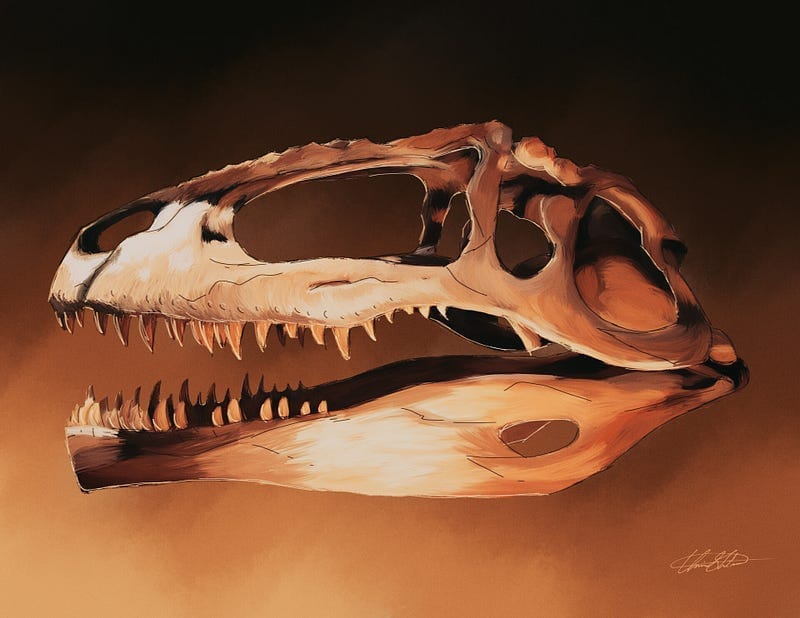
The teeth were curved and longer than other theropods, making it all the more dangerous. The bite was 10,000–13,000 newtons- not to high but still a good bite. What Giganotosaurus carolinii did was inflicting sharp wounds which leads to severe blood loss, then waited for the prey to weaken to inflict the final bite.
Tail
The tail of Giganotosaurus carolinii was long and stiffened. It was also reinforced by ligaments making it strong. The function of the tail was to act like a counter balance to the heavy front. The tail prevented Giganotosaurus carolinii from tipping during turning and lunging.
The Wrong Look
In Jurassic World Dominion, Giganotosaurus carolinii was shown to be scaly with large osteoderms like a crocodile. While that does look cool, It isn’t accurate. Giganotosaurus carolinii probably had smooth, really small scales.
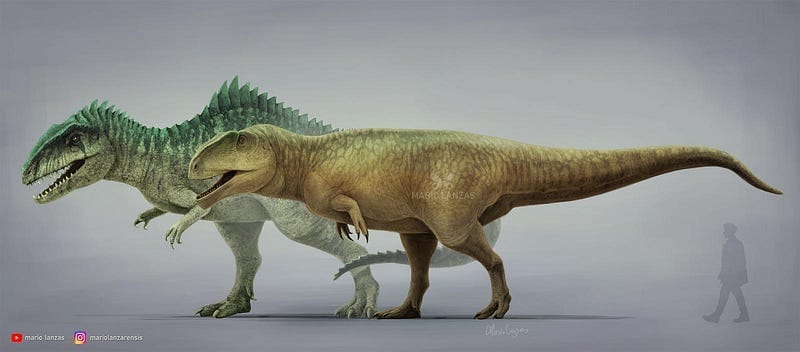
(The one more to the left is JWD and the one more to the right is an accurate model from our understanding)
Final Thought
Giganotosaurus was a giant built for balance, efficiency, and precision, with a lightweight skull, slicing teeth, powerful legs, and a stabilizing tail all working as one system. Every part of its body shows that survival at this scale was not about being the strongest, but about being perfectly adapted to its role.
If you appreciated this list please subscribe to our newsletter!